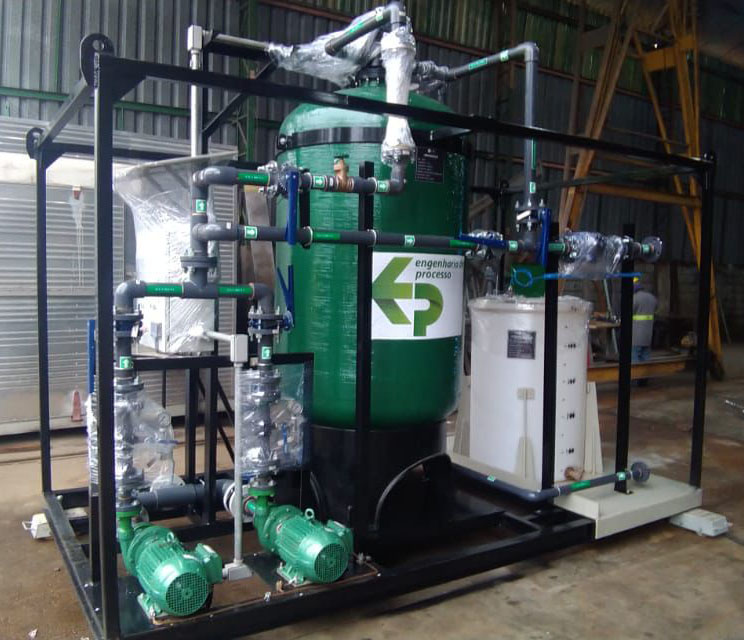
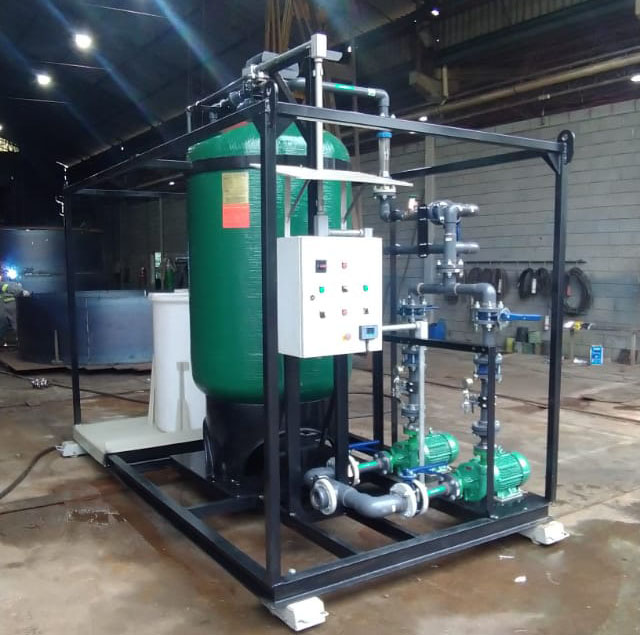
Water softening is a water treatment technique designed to reduce water hardness by removing calcium and magnesium ions. Water that contains a significant amount of calcium and magnesium is called hard water, which can clog pipes and interfere with the dissolution of soap and detergent in water. The water softener works through a process called ion exchange, in which the calcium and magnesium ions present in the water are exchanged for sodium ions.
The water softening system consists of an exchange unit with a cationic resin bed and a brine saturation tank. Raw water is fed into the unit through an inlet at the top and distributed across the cross-sectional area of the bed, through which it flows downward, with the softened water being collected by strainers installed on the false bottom that supports the bed, which then direct it to the vessel’s lower outlet. Regeneration can be performed manually or automatically by passing a 10% brine solution in a downward flow through the resin; the regenerating solution is introduced into the vessel through a dedicated distributor located slightly above the bed.
The cationic resin used in water softeners is a solid chemical substance. Water is passed through the resin so that calcium and magnesium ions bind to it and sodium ions are released into the water. This results in softer water that is less prone to limescale buildup.
Softener is used in industrial applications not only to reduce water hardness but also to protect hot and cold water equipment such as boilers, heat exchangers, piping from damage caused by hard water and also improve water treatment efficiency. .