




The discussion about water has gone up a level. Recently, the UN brought up the term water bankruptcy, increasing the seriousness of what we used to call a “crisis”.
This change in terminology reflects a critical scenario: the availability and quality of water can no longer sustain demand, whether due to pressure on water sources or the continued degradation of resources, the system has reached its limits.
But how does water failure affect industry?
Everything. Operations, costs and production capacity. Water is the resource that is directly linked to business continuity.
For the industrial sector, water is not just an environmental resource, it is a critical input for continuity.
When this resource becomes limited or unstable, the impact is not only environmental, but also operational and economic.
Water management has come to focus on three main risks:
- Availability: regions with catchment restrictions and competition between uses
- Regulationstricter environmental standards and more active monitoring
- Costincrease in treatment, collection and disposal
Companies that maintain inefficient water use models are more exposed to these three factors simultaneously.
Water reuse in industry: engineering applied to operational continuity
In a scenario of restricted abstraction, rising costs and stricter regulations, relying exclusively on external sources of water increases exposure to risk. This is where reuse becomes a structural element of the operation.
By reintroducing the treated effluent into the process itself, the industry reduces its dependence on abstraction, stabilizes water availability and gains greater control over critical production variables.
In practice, it’s about reusing the resource, reducing costs and gaining resilience in the face of scarcity scenarios.
Real application: reuse on an industrial scale
The application of reuse systems is already present in industrial operations that treat water as a critical element for their continuity.
One example is Scania’s operation, where industrial and sanitary effluent is treated and reintroduced into the production process to a high standard of quality.
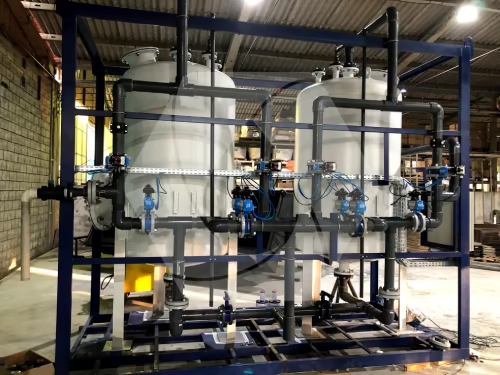
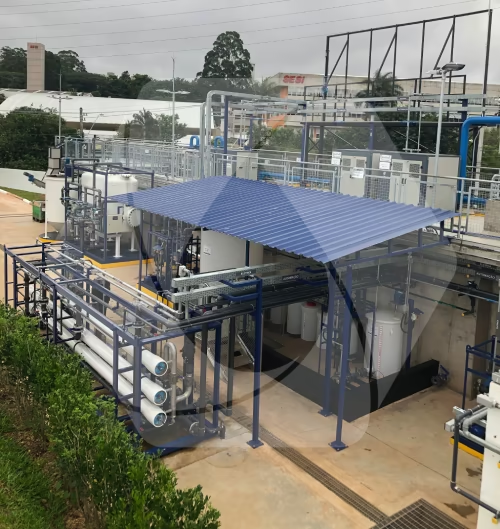
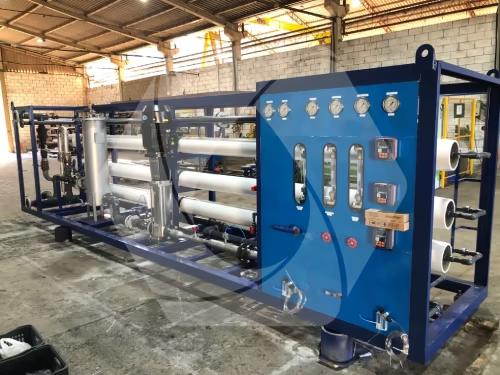
The system implemented by EP integrates biological treatment by MBR (Membrane Bioreactor) and advanced stages with reverse osmosis, making it possible to transform effluent that would otherwise be discarded into water suitable for use in the plant’s cooling and utilities systems.
With a treatment capacity of approximately 15m³/h, the solution was structured to meet not only environmental compliance, but also the plant’s operational efficiency.
The result is straightforward:
- around 80% of effluent is converted into reuse water
- significant reduction in dependence on water supplied by the concessionaire
- greater control and predictability over the water bill
- greater control over the quality of the water used in the process
- proper disposal of waste, with external reuse (donation for non-noble purposes – washing and wetting public roads, for example)
In addition to the treatment stages, the project involved complete engineering, automation, continuous operation and remote telemetry monitoring (STEP), guaranteeing stability and performance over time.
This type of application shows how reuse is consistently integrated into the industrial routine, helping to reduce exposure to water risks, optimize resources and meet environmental and market requirements.
EP Group: complete performance in water management
The EP Group operates throughout the industrial water chain:
- Environmental analysis
- Engineering and implementation
- Supply of technologies e supplies for water and effluent treatment
- System operation and optimization
- Remote Monitoring and Operation Software
This integration makes it possible to monitor the complete water cycle within the industrial operation.
Throughout our history, we have produced more than 700 million m³ of reuse water produced.
Water reuse and water management: what industry needs to do now
Water shortages are imposing new demands on industry.
Water becomes a resource that needs to be managed with the same priority as any other critical input in the operation.
In this context, reuse has become one of the main ways of ensuring water efficiency, reducing exposure to risks and sustaining operational continuity, as well as being fully aligned with ESG principles.
More than an adjustment, it’s a strategic choice.
If your operation still relies exclusively on external funding, now is the time to review your water management.
We at Grupo EP are pioneers in the implementation of reuse systems in industries, with plants in operation for over 20 years. We can take you to see some of them in person!
Talk to Grupo EP and find out how to apply reuse in practice, safely and efficiently.